The Writing Virus
BLOGS ABOUT WRITING THEORUM
I have a strong instinct for communication and an appreciation for the power of a well-chosen word, but underneath the writing and creativity is something more fundamental: I want things to be useful. Whether I’m talking about adversity, disability, writing or personal development, I’m usually looking for a way to turn an observation into something another person can actually take away and use.
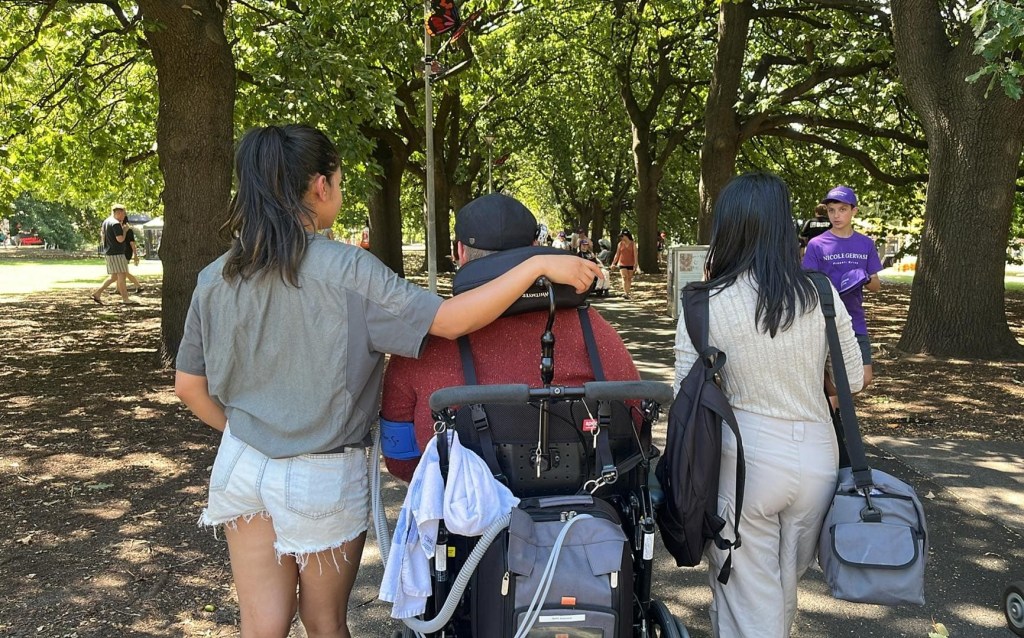
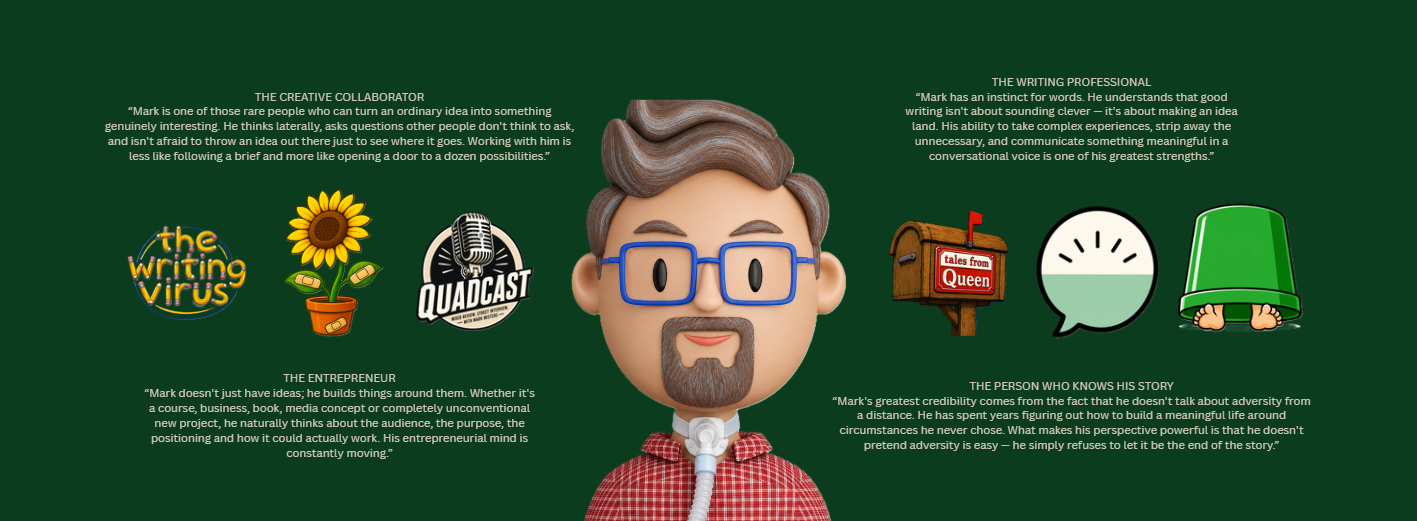
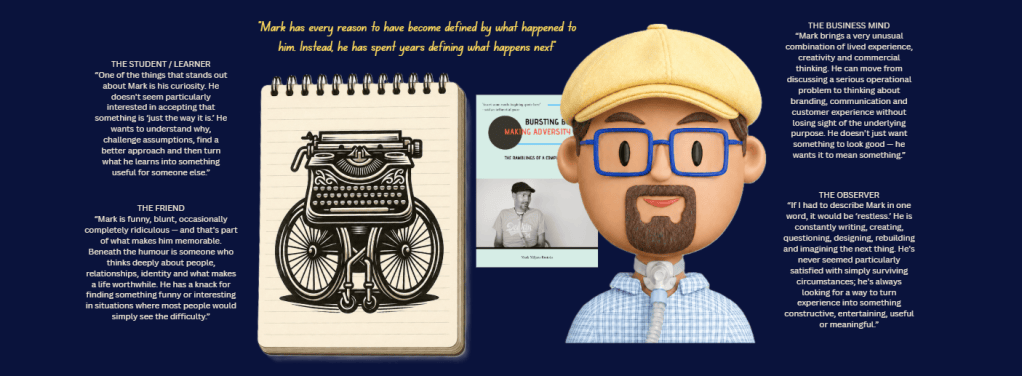
Mark is a writer at heart, with his eyes on a career as an advertising copywriter. A published author, an advice columnist, he also studies marketing and creative writing at university. A certified life coach, marketing consultant and very active blogger. On a more personal note, Mark advocates for both adversity and chronic illness; stemming from his own twenty-year battle with quadriplegia. He is wheelchair-bound, non-verbal, has a tracheostomy tube and is 24/7 ventilator dependant. His dream is to one day get better and ride a bicycle around Australia,

Using Writing as a Healing Tool
What Twenty Years of Quadriplegia has Taught Me
Over the years, I’ve built my professional life around understanding people and their struggles: disability, resilience and the lessons that can come from difficult circumstances. I’m the founder of The Writing Virus, an advice columnist at Halfway Decent Advice, and I teach the lessons I’ve learnt through Adversity University.
Through these different projects, I’ve found myself constantly coming back to the same questions: What actually happens to a person when their identity is taken away? How do you deal with permanent dependency? What happens when the future you imagined disappears? And how do you find purpose when your circumstances place very real limits on what you can do?
I’ve experienced the psychological impact of losing the person you thought you were going to become. I’ve experienced the frustration and vulnerability of depending on other people. I’ve experienced the grief that comes with watching certain possibilities disappear – and just grown with it.
The Plague: Writing Education
Writing is about communicating ideas clearly, efficiently and purposefully, without unnecessary words or complexity. Good writing education teaches this, through the use of structure, frameworks, paragraph development, sequencing, introductions, conclusions and logical flow. It also develops an understanding of style and prose, including tone, voice, rhythm, word choice, sentence construction, imagery and writing for different audiences.
Writers should learn a broad range of disciplines, including storytelling, persuasive writing, copywriting, research, dialogue, descriptive writing, editing, proofreading and rewriting. Ultimately, learning to write succinctly teaches people to think clearly, prioritise ideas and ensure that every sentence, paragraph and word serves a purpose.
Advice Columnist
I’ve experienced enough of life’s ups, downs, absurdities and unexpected turns to offer advice grounded in real-world experience rather than theory. I’m honest, practical and unafraid to tackle difficult questions with a mix of empathy, perspective and a healthy dose of humour. Most importantly, I understand that sometimes people don’t need perfect answers — they just need someone who can help them see their situation differently.
Advertising Copywriter
I understand how to turn real human experiences, emotions and ideas into words that people actually want to read. I bring a distinctive combination of storytelling, humour, curiosity and lived perspective, allowing me to find the compelling angle that makes a product, brand or message stand out. I don’t just write copy — I look for the story, the hook and the human connection that makes people stop, think and act.
Life Coach
I don’t just teach resilience, mindset and overcoming adversity — I’ve lived them through more than two decades of extraordinary challenges. My experiences have given me a rare perspective on rebuilding a life when circumstances fundamentally change, and finding purpose, opportunity and meaning where others might only see limitations. I bring that lived experience, honesty and practical perspective to help people stop simply surviving adversity and start creating a life they genuinely want to live.
What can I build from here? How can we better connect?
I’m not interested in telling people to simply “bounce back.” I think that phrase can be completely inadequate when someone is dealing with permanent, life-changing circumstances; or even with a rough and tumble predicament. Sometimes there is no bouncing back. Sometimes you have to reorganise your entire life around what has happened.
You have to find a new identity. A new purpose. New expectations. New ways of connecting with people. New definitions of success. And, sometimes, a completely new understanding of what a good life can actually look like.
Share your message, stand for something, be an ambassador, advocate, follow a passion, be vulnerable, tell a personal story; this is the gold my friend. Very worthwhile. It all brings life. They ooze authenticity, even give you more dimension. And, this is what also makes you interesting (even desirable).
— Mark in Melbourne
Social Media

